
Menopause and Migraine: Causes, Symptoms and Treatment

In short
For many women, migraine and headache are tied to estrogen. During perimenopause estrogen swings sharply, and it is those swings that can trigger or worsen attacks. After menopause, once levels become low and stable, the complaints often ease again. Do you have migraine with aura? Then the decision around hormone therapy calls for an individual assessment by a doctor.
What does estrogen have to do with migraine?
Migraine is more than a headache. It is a neurological condition in which the brain responds more sensitively to stimuli, and estrogen plays a part in that. Among other things, the hormone influences serotonin and the way pain signals are processed.
It is not the level of your estrogen that is the trigger, but the change in it. A rapid drop in estrogen makes the brain more vulnerable to an attack. That is also why migraine is roughly three times more common in women than in men: the hormonal cycle produces exactly these fluctuations month after month (Association of Migraine Disorders).
How do you recognise hormonal migraine?
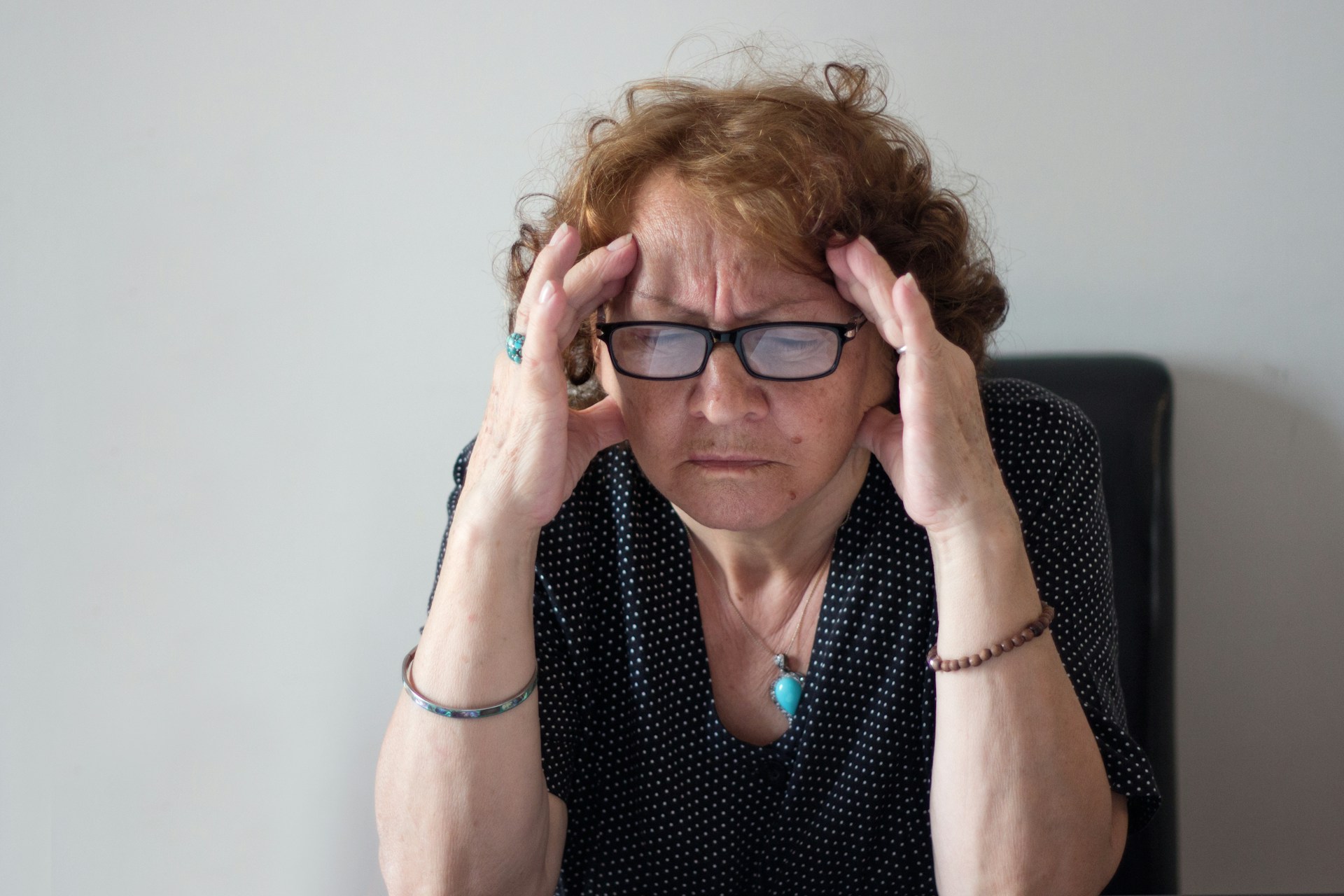
The main features are a one-sided, pounding or throbbing headache of moderate to severe intensity, nausea (sometimes with vomiting) and oversensitivity to light and sound. An attack lasts from 4 to 72 hours and worsens with physical exertion.
In migraine with aura, temporary neurological signs come before the headache: visual disturbances (zigzag lines, flickering, blind spots), tingling in an arm or the face, or speech problems. Such an aura usually lasts 20 to 60 minutes. Whether or not aura is present is clinically relevant to the decision around hormone therapy (see below).
Tension headache feels different: a pressing sensation on both sides of the head, without nausea, and not worse with movement. Not sure which type you have? Have your general practitioner make the diagnosis.
Why does migraine often get worse in perimenopause?
Perimenopause is the phase in which your hormones are at their most unpredictable. The ovaries produce estrogen in fits and starts: levels can peak above normal and then fall sharply. It is precisely those abrupt drops that are powerful triggers. For a brain that is sensitive to change, this is a difficult stretch.
In practice we see that women in this phase report more frequent or more severe attacks, and that attacks sometimes respond less well to the usual medication. The National Migraine Centre describes it this way: as menstruation becomes more irregular and more frequent, migraine attacks often do too, and “the main reason for worsening migraine around menopause is the fluctuation of estrogen” (National Migraine Centre).
I used to get migraine around my period. Does that matter now?
Yes, that is an important signal. Women with a history of menstrual migraine, attacks that kept coming around their period, are often the very women who suffer most during perimenopause.
The cause is the same: those attacks were triggered by the natural estrogen drop just before menstruation. In perimenopause, drops like that come more often and more irregularly. If you recognise this pattern, mention it to your doctor. It helps to place the complaints in the right context.
Does migraine improve after menopause?
For many women it does, though it takes time. Once your ovaries have wound down their hormone production, estrogen levels become low and stable. Without the sharp swings, the main trigger disappears for some women. Stable, low levels are a good deal less problematic than strongly fluctuating ones.
The figures point the same way: around two in three women with migraine without aura see their complaints clearly diminish after menopause (Association of Migraine Disorders). The National Migraine Centre adds that this can take two to three years after the last period, because it can take that long for the hormones to settle.
One honest caveat: this does not apply to everyone, and with a surgical menopause (removal of the ovaries) migraine can actually get worse.
Which lifestyle factors trigger headaches?
Hormones are not the whole story. Menopause often also brings poorer sleep, more stress and changing habits, and these are all well-known triggers. They frequently stack on top of the hormonal sensitivity.
Common lifestyle triggers:
- Sleep: too little or irregular sleep, partly due to night sweats
- Stress: and sometimes the relaxation afterwards, the so-called weekend headache
- Caffeine: both too much and suddenly cutting back
- Dehydration: drinking too little across the day
- Skipping meals: swings in blood sugar
You cannot switch off every trigger, but regularity in sleep, eating and drinking gives your brain fewer openings for an attack. Stress management, such as breathing exercises or cognitive behavioural therapy, and regular, moderate exercise can also lower the frequency of attacks. For magnesium, riboflavin (vitamin B2) and coenzyme Q10 there is modest scientific evidence of a preventive role; discuss this with your doctor. Small, achievable steps work better here than one big overhaul all at once.
Medication
Alongside lifestyle and any hormone therapy, there is medication that treats an attack or helps prevent one.
Treating an attack: paracetamol or ibuprofen as a first step; triptans (such as sumatriptan or rizatriptan) are more effective for moderate to severe attacks. Do not take attack medication more than two to three times a week, because frequent use can lead to medication-overuse headache.
Preventive treatment: if you have three or more disabling attacks a month, preventive medication is worth considering. Beta-blockers, amitriptyline or topiramate are proven options. For chronic, difficult-to-treat migraine, the neurologist may consider CGRP antibodies or botulinum toxin. Which medication is appropriate is something a doctor assesses together with you.
Migraine with aura and hormone therapy: what to watch for
This part calls for precision. Migraine with aura, the temporary visual or sensory signs just before an attack, is associated with a higher risk of ischaemic stroke. At the individual level that risk is small, but it counts in the assessment of whether and how you use estrogen.
An important distinction is between the contraceptive pill and menopausal hormone therapy. The combined pill contains a high dose of synthetic estrogen and is not advised in migraine with aura. Menopausal hormone therapy works with lower, body-identical doses. According to the British Menopause Society, migraine, with or without aura, is not on its own a reason to forgo hormone therapy. It does influence the choice: administration through the skin (patch or gel) is preferred, because it gives more stable levels and does not raise the risk of stroke.
The form of progesterone plays a part too: bio-identical progesterone does not carry extra vascular risk and is therefore preferred when progesterone is needed. At Menovia we include migraine and aura as standard in the contraindication check, and we deliberately choose transdermal estradiol and bio-identical progesterone because this offers the most favourable risk profile for women with hormonal headaches.
What is appropriate for you depends on your personal situation: the type of migraine, any other risk factors, and the route, form and dose. That assessment is made by a BIG-registered doctor together with you, and not by a general article. That is why we deliberately give no blanket yes or no.
When should you contact your (general) doctor?
Migraine is unpleasant but usually not dangerous. Even so, there are headache complaints that do call for assessment. Contact your general practitioner in the case of:
- a sudden, very severe headache that is new to you (like a thunderclap)
- a new type of headache or aura that appears for the first time after the age of 50
- headache with focal signs: loss of strength, speech or vision problems that do not resolve
- headache with fever, a stiff neck or confusion
- a clear change in the pattern or the severity of your attacks
A referral to the neurologist can be worthwhile if you have more than three disabling attacks a month, if attack medication does not help enough, or if the pattern of your headache changes markedly. Not sure, or are the complaints taking over your daily life? Then discuss it with a doctor. At Menovia we look at the whole hormonal system rather than at one complaint on its own, so that headache is assessed in the broader context of your menopause.
Frequently asked questions
Can menopause cause migraine in someone who never had it?
It can. Some women develop migraine or aura for the first time in perimenopause because of the strongly fluctuating estrogen levels. Always have a new aura after the age of 50 assessed by a doctor first.
Is it migraine or an ordinary headache?
Migraine is usually one-sided, pounding, and often comes with nausea and oversensitivity to light or sound. Tension headache feels more like a pressing band around the head. A doctor can help you tell the difference.
Does hormone therapy help against hormonal migraine?
In some women, stabilising the estrogen level can contribute to fewer attacks, but it is not a standard treatment for migraine and does not work for everyone. Whether it is appropriate depends on your situation and is assessed individually.
Why through the skin and not as a tablet?
Administration through the skin (patch or gel) gives more stable estrogen levels than a tablet and does not raise the risk of stroke. That is why this route is often preferred in migraine.
Will my migraine disappear once menopause is over?
For around two in three women, migraine improves after a natural menopause, though that can take two to three years after the last period. It is not a guarantee.
Summary
Migraine and headache in menopause stem from fluctuating estrogen levels, especially in the erratic perimenopause. If you had menstrual migraine earlier, the chance of it worsening is greater. After menopause the complaints ease again for many women. Lifestyle, sleep, stress, caffeine and dehydration, all help determine how often you are affected. If you have migraine with aura, the decision around hormone therapy calls for an individual assessment by a BIG-registered doctor, weighing route, form and dose.
*This article is intended as an educational source of information and does not replace medical advice, diagnosis or treatment. No rights can be derived from its content. For complaints or questions about your personal situation, we recommend consulting a doctor.*
Free guide: menopause, a broader view
Menopause is more than hot flushes. In our free menopause guide, our doctors explain what is happening hormonally in your body, which complaints you often do not associate with it, and what treatment options exist. In plain language, medically grounded. Download the free guide.
Free guide: menopause, a broader perspective
The menopause is about more than just hot flashes. In our free menopause guide, our doctors explain the hormonal changes happening in your body, the symptoms you might not immediately associate with it, and the treatment options available. Written in plain language and medically backed.

Read more blogs about the menopause
Menovia
Sign up today