
FSH levels and what they say about menopause
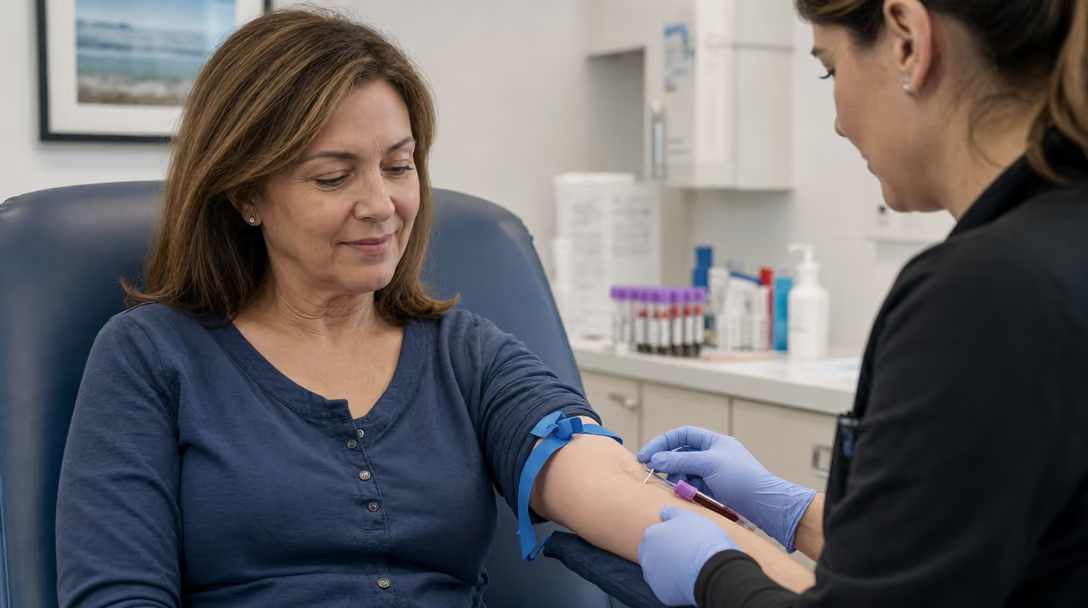
An FSH level gives an impression of how hard your pituitary gland is driving your ovaries, but it is a limited marker for menopause. In women over 45 with recognisable symptoms, doctors identify menopause based on the clinical picture, meaning your symptoms and the pattern of your periods, and not on a single blood value. FSH fluctuates strongly from one cycle to the next, which makes a single measurement unreliable and often not even necessary.
By Menovia
In short
- FSH (follicle-stimulating hormone) rises as the ovaries make less estrogen, but the value varies strongly from cycle to cycle and sometimes from week to week.
- For women over 45 with typical symptoms, an FSH test is usually not needed; the diagnosis is clinical (NHG guideline, NICE).
- A single measurement is a snapshot. A normal result does not rule menopause out, and a high result does not prove it.
- Measuring FSH can be useful under 40 (suspected early menopause) or to exclude other causes, such as the thyroid.
- FSH and AMH measure different things, and neither one precisely predicts when your final period will fall.
What is FSH and why does it change in menopause?
FSH is made by the pituitary gland and prompts the ovaries to mature egg cells. As the ovaries produce less estrogen during perimenopause, the pituitary works harder and the FSH level in the blood rises.
That makes FSH a useful marker, but not a conclusive one. In perimenopause the ovaries still work irregularly, so FSH can be high one month and low again the next while nothing has changed in your situation. That fluctuation is exactly why a single value says less than many women think.
What does an FSH level tell you, and what does it not?
An FSH level shows how hard your pituitary has to stimulate the ovaries at that moment. It says nothing about how many egg cells you have left, and it does not precisely predict when your final period will fall.
Laboratories also use different reference ranges. Broadly, an FSH above roughly 25 to 40 IU/L fits the postmenopause, and values below 10 IU/L usually fit the fertile phase, with a wide zone in between. Those cut-offs differ per test and per laboratory. If blood is drawn while your cycle is still regular, it usually happens early in the cycle, around day 2 to 5. But in menopause in particular, that single number says little, because it varies so strongly.
Not sure whether your symptoms belong to menopause or come from somewhere else? A broader look at your hormones and lifestyle can help put a blood test result in perspective. Download the free guide →
Is an FSH test needed to identify menopause?
Usually not. The NHG guideline De overgang and the British NICE guideline advise against routine FSH testing in women over 45 with recognisable symptoms. The reason is the same fluctuation: the value varies too strongly to be reliable.
In practice this means the diagnosis rests mainly on the clinical picture. If you are over 45, have not had a period for twelve months, or have hot flashes combined with irregular periods, that is usually enough to identify menopause or perimenopause. Honestly, a blood test rarely adds anything at that point.
When can a blood test be useful?
There are situations where a blood test does add value. If you are younger than 40 and your periods stop or become irregular, FSH, together with estradiol, can help detect an early menopause. Between 40 and 45, a doctor may consider an FSH measurement if the picture is unclear.
A blood test can also help exclude other causes of your symptoms. Complaints that look like menopause can also fit an underactive or overactive thyroid; read more about the role of the thyroid during menopause. Anemia, a vitamin deficiency, or other hormonal problems can cause similar symptoms too.
What is the difference between FSH and AMH?
FSH and AMH do not measure the same thing. FSH says something about the hormonal signalling right now. AMH (anti-Mullerian hormone) gives an indication of ovarian reserve, meaning a rough measure of how many egg cells are left.
Important to know: AMH is mainly a marker for fertility and does not precisely predict the timing of menopause at an individual level. At group level AMH declines with age, but for you personally it is too imprecise to say when your final period will fall. FSH and AMH therefore complement each other; they are not interchangeable.
How do we at Menovia look at an FSH result?
At Menovia we never read an FSH value on its own as proof of menopause. Our BIG-registered doctors always weigh the result together with your symptoms, your age, the pattern of your periods, and your medical history. Whether, and if so which, treatment is appropriate follows from that overall picture. A blood test can be part of it, for example to exclude other causes or to keep an eye on things during hormone therapy.
Where we do treat, bio-identical hormones are central, with lifestyle as a valuable addition. A single number does not decide that plan; the clinical picture does.
When to see a doctor
Contact your GP or a doctor in case of:
- Symptoms that clearly affect your daily life, such as your sleep, your mood, or your work.
- Irregular or heavy bleeding, bleeding between periods, or any bleeding after menopause. This should always be assessed.
- Menopausal symptoms before the age of 40, or the absence of periods at a young age.
- Symptoms that look like menopause but could also fit something else, such as heart palpitations, unintentional weight loss, or extreme fatigue.
- Doubt about whether hormone therapy is right for you, so a doctor can weigh the benefits and drawbacks with you.
Frequently asked questions
What is a normal FSH level during menopause? There is no single number that proves menopause. Broadly, an FSH above roughly 25 to 40 IU/L fits the postmenopause and values below 10 IU/L fit the fertile phase, but the cut-offs differ per laboratory and the value varies strongly.
Is a one-off FSH measurement reliable? No, a single measurement is a snapshot. Because FSH can fluctuate from cycle to cycle, a single result gives a distorted picture; a repeat measurement together with estradiol says more.
Can the contraceptive pill affect the FSH result? Yes. Hormonal contraception and a hormonal IUD can suppress the FSH value. Discuss with your doctor whether an adjusted testing moment is needed.
Can my FSH be normal while I still have symptoms? Yes. Symptoms can arise from hormone fluctuations before FSH rises structurally. A normal value therefore does not rule out the early phase of menopause.
FSH or AMH: which test should I do? That depends on your question. FSH says something about the signalling now, AMH something about ovarian reserve. Neither precisely predicts when your final period will fall, and with typical symptoms over 45 a test is often not needed.
At which FSH level does hormone therapy start? There is no fixed threshold. A doctor weighs your symptoms, age, cycle pattern, and history together; the treatment choice rests on the overall picture, not on a single number.
Sources
- Nederlands Huisartsen Genootschap. NHG-standaard De overgang (M73). richtlijnen.nhg.org
- National Institute for Health and Care Excellence. Menopause: identification and management (NG23). nice.org.uk
- Thuisarts.nl. Ik ben in de overgang. thuisarts.nl
- Moolhuijsen L, Visser J, et al. The role of anti-Mullerian hormone in ovarian reserve and the prediction of menopause. Endocrine, review. link.springer.com
- MedicalNewsToday. FSH Levels: Normal, high, and low ranges. medicalnewstoday.com
This information is intended as an educational resource and does not replace medical advice, diagnosis, or treatment. For complaints or questions about your personal situation, we recommend consulting a doctor.
Free guide: menopause, a broader perspective
The menopause is about more than just hot flashes. In our free menopause guide, our doctors explain the hormonal changes happening in your body, the symptoms you might not immediately associate with it, and the treatment options available. Written in plain language and medically backed.

Read more blogs about the menopause

Menovia
Sign up today